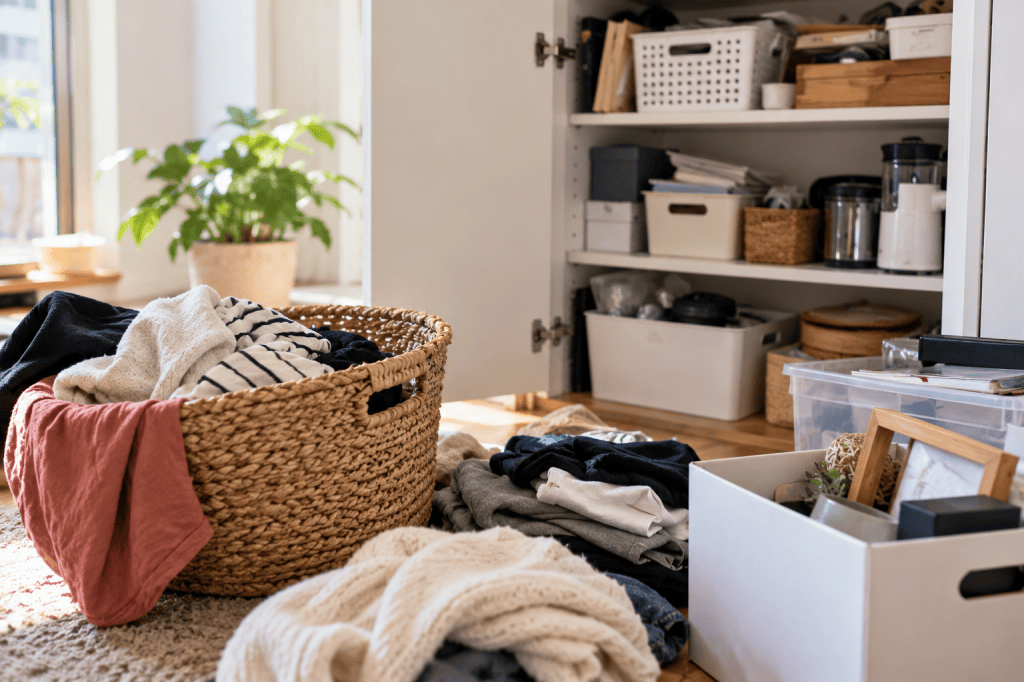
There are things in our homes that we haven’t used in years. Clothes that no longer fit, kitchen gadgets tucked away in cupboards, books we haven’t opened and drawers filled with things we barely remember putting there.
We know they’re taking up space. We know we probably don’t need them. Yet when we finally decide to have a clear-out, something makes us hesitate.
An old jumper reminds us of a particular time in our lives. A gift we never really liked feels difficult to give away because someone chose it for us. Something we bought and never used reminds us how much money we spent.
What seemed like a simple afternoon of tidying suddenly becomes a series of decisions we weren’t expecting to make.
Emotional attachments
Our homes collect more than possessions. They hold memories, intentions, unfinished plans and reminders of who we used to be.
A dress hanging in the wardrobe might belong to a time when we went out more often. Exercise equipment gathering dust might represent a routine we genuinely intended to start. A collection of craft supplies might remind us of something we once enjoyed, or something we still hope to find time for.
Getting rid of these things can feel strangely personal. We aren’t necessarily attached to the objects themselves. Sometimes we’re attached to what they represent.
And not everything we keep needs to be useful. An old photograph, a handwritten letter or something that reminds us of someone we love can have value that has nothing to do with how often we use it.
The difficulty comes when we can no longer tell the difference between something we genuinely treasure and something we’re keeping because letting it go feels uncomfortable.
Keeping things just in case
Then there are all the things we keep because they might come in handy one day.
Spare cables for devices we no longer own. Containers without matching lids. Packaging from something expensive. A drawer full of miscellaneous bits and pieces that seem too useful to throw away, even though we haven’t found a use for them yet.
The reasoning makes sense at the time. Why throw something away if we might need it later?
But keeping things has a cost too. Every item needs somewhere to live. Every crowded cupboard becomes a little harder to use. Sometimes we end up buying something we already own simply because we can’t find it.
There’s also the money we’ve spent. Throwing away something expensive can feel wasteful, even when keeping it doesn’t make that money come back. We tell ourselves we’ll use it eventually, and perhaps we will. But sometimes the object stays in the cupboard for another five years, still waiting for its moment.
At some point, it might be worth asking whether we’re keeping something because we genuinely expect to use it, or because we don’t want to admit that we probably won’t.
Decluttering fatigue
A lot of decluttering advice makes the process sound straightforward. Take everything out, sort it into piles, decide what stays and what goes, then put everything back neatly.
In reality, taking everything out can be the moment things go wrong.
The contents of a cupboard end up spread across the floor. One decision leads to another. Something belongs in a different room, so we take it there and notice another job that needs doing. Halfway through, we’re tired, the room looks worse and the thought of finishing becomes overwhelming.
It isn’t necessarily the physical work that exhausts us. It’s the constant decision-making.
Do we need this? When did we last use it? Could someone else use it? Should we sell it? Where would we sell it? Is it worth the trouble? What if we regret getting rid of it?
Multiply those questions by everything in a cupboard, and a small organising job can become surprisingly demanding.
Perhaps that’s why some of us keep putting it off. We know how satisfying a clear space can feel, but we also remember the effort it took to get there.
Where to start
There is something appealing about the idea of a completely organised home. Cupboards where everything has a place, drawers that open without getting stuck and surfaces that stay clear.
But most of us live in homes that are actually being used.
There are groceries to put away, washing waiting to be folded, paperwork to deal with and people who don’t always put things back where they belong. A perfectly arranged cupboard might look wonderful on the day it’s finished, but it still has to work on an ordinary Tuesday when everyone is busy.
Instead of trying to transform an entire room, it may be more useful to start with the spaces that regularly frustrate us.
The kitchen drawer that never closes properly. The bathroom cupboard where things fall out whenever we reach for something. The shelf where we keep moving the same objects around to find what we need.
These small inconveniences are easy to overlook because we’ve become accustomed to them. Yet sorting out just one can make an everyday routine noticeably easier.
And sometimes the answer isn’t buying another organiser or finding a clever way to squeeze more into a cupboard. Sometimes it’s simply deciding that we don’t need to keep everything that’s already there.
Living with less clutter
Decluttering doesn’t have to mean becoming a minimalist or getting rid of everything that doesn’t serve an obvious purpose.
A home should still feel like somewhere we belong. There should be room for the things we love, even when they aren’t particularly practical. The aim isn’t to remove every sign of living, but to make everyday life a little easier.
There may always be a cupboard that needs attention or a drawer that could do with another clear-out. Homes change as our lives change, and what works today may not work a few years from now.
Perhaps the hardest part of decluttering is accepting that we don’t have to keep everything simply because it once mattered, cost money or might be useful someday.
Letting go of something doesn’t erase the memory attached to it. Giving away an unused purchase doesn’t make the original decision a failure. And making space doesn’t mean we have to fill it again.
Maybe decluttering isn’t really about having less.
Maybe it’s about having a little less to look after, a little less to search through and a little more room for the life we’re living now.

